Loyalty, fear, and stopping a revolt
Citizen mood is a live system, not a bar. Dissent escalates into revolt if left alone — and the trait that decides who breaks first is written on their card.
Last verified
· Game build 0.184.0.196275
The four states
The game names exactly four states for a working citizen. They are not a single slider — they describe how someone is reading the State, which is a different thing from how happy they are.
| State | What it means |
|---|---|
| Grateful | Rule through comfort and prosperity and citizens read the State as a provider. |
| Loyal | The stable end state of either doctrine — the one you are actually farming for. |
| Afraid | Fear works, but Faint-hearted citizens break under it faster than the rest. |
| Quietly rebellious | The pre-revolt state. Dissent escalates into revolt if you ignore it. |
Two doctrines, both supported
| Rule by fear | Rule by comfort | |
|---|---|---|
| Tools | Fear, propaganda, surveillance, punishment | Comfort and prosperity |
| Speed | Fast — applies immediately | Slow — has to be built and sustained |
| Resource cost | Lower up front | Higher: food, housing, quality of life |
| Fails against | Faint-hearted citizens, who break sooner | Impatience — it does not solve an acute crisis |
| Trait that loves it | Conformist — "views punishment as justified" | Anyone without a fear-facing trait |
The Conformist trait is the clearest evidence that the game models doctrine fit rather than a global mood number. Its exact wording: "Stronger positive response to directives and Glory Assemblies; views punishment as justified." A colony of Conformists under a fear doctrine is stable. The same doctrine applied to Faint-hearted citizens — "Fear accumulates faster; lower breakdown threshold" — is not.
The signals that arrive before a revolt
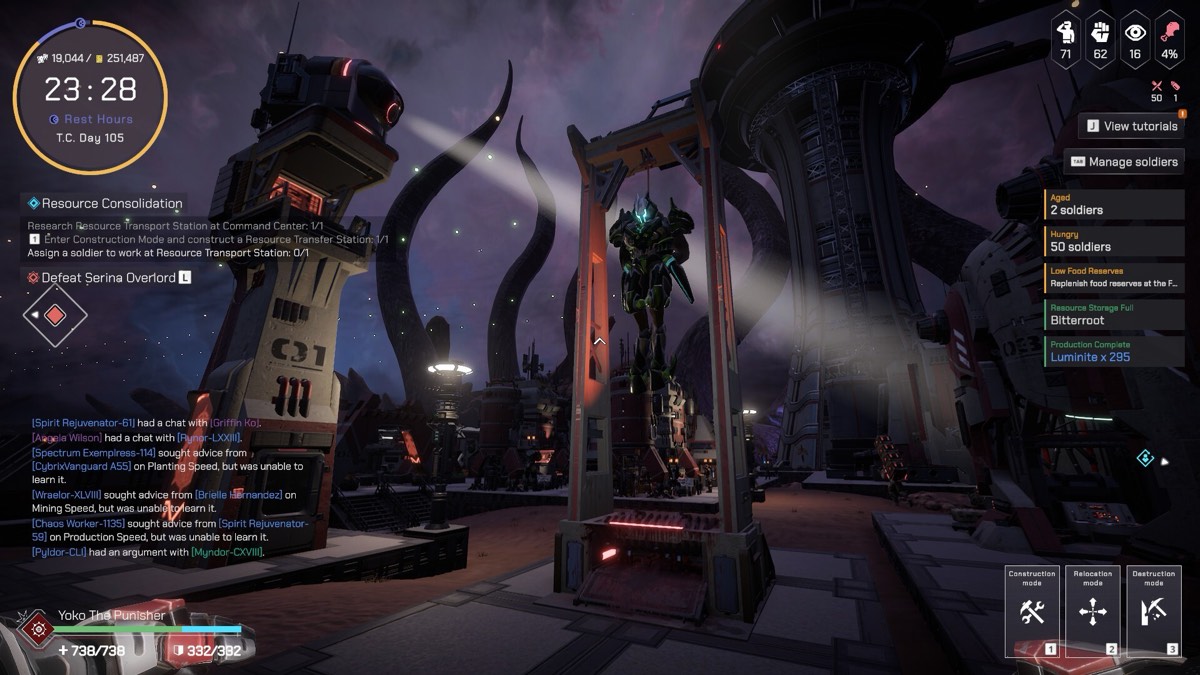
The game is unusually talkative. Use it.
| Signal | What it is telling you |
|---|---|
Exhausted | A named citizen has run their stamina out and needs rest. |
Overwork | A count of soldiers currently past their limit. |
Low Food Reserves | Replenish food reserves at the Kitchen. |
Production Complete | A workshop finished an item — e.g. Radiant Fighter Chest Plate IV ×1. |
Pending Imprisonment | A captive is queued for a cell but does not have one yet. |
Beyond the alert stack, the event log narrates social life: citizens chatting, seeking advice and failing to learn a skill, and having arguments. A colony where the log is mostly arguments is a colony with a social problem you can still fix.
What to actually do
- Fix the physical cause first. Exhausted and Overwork alerts are fatigue, and fatigue is a schedule problem. Rest Hours exist.
- Feed them properly. Low Food Reserves is a Kitchen problem, not a farm problem.
- Match people to doctrine. Move Faint-hearted citizens away from your highest-punishment areas if you rule by fear.
- Do not over-suppress the opposition. Community consensus — and the game's own framing of dissent as escalating — is that crushing it hardest is not what settles it.
- Do not read approval as stability. They are different things, and this trips up experienced strategy players specifically.
Frequently asked
How do I stop a revolt in Pax Autocratica?
Act on the state before the state changes: watch for quietly rebellious citizens, fix the actual driver (fatigue, food, punishment load), and stop assuming approval equals stability.
Is fear or comfort better?
Both are supported paths. Fear is faster to apply and cheaper in resources; comfort is slower but does not punish Faint-hearted citizens. The mistake is running both inconsistently.
What does “quietly rebellious” mean?
It is the pre-revolt state. The game describes dissent as escalating until it becomes revolt, so a quietly rebellious citizen is a countdown you can still stop.
Does executing rebels work?
Execution is described as producing a warning to would-be rebels rather than labour. It is a deterrence tool, and community reporting suggests over-suppression radicalises rather than settles opposition.
Read next
- Every citizen trait — With exact in-game wording
- Converting enemies — Where a lot of instability arrives from
- Policies — The research that changes how you rule